Showing posts with label Oregonian work. Show all posts

Sunday, May 10, 2015

Pray the gay away?

Portland Fellowship

"My continuing passion is to part a curtain, that invisible veil of indifference that falls between us and that blinds us to each other's presence, each other's wonder, each other's human plight.” - Eudora Welty


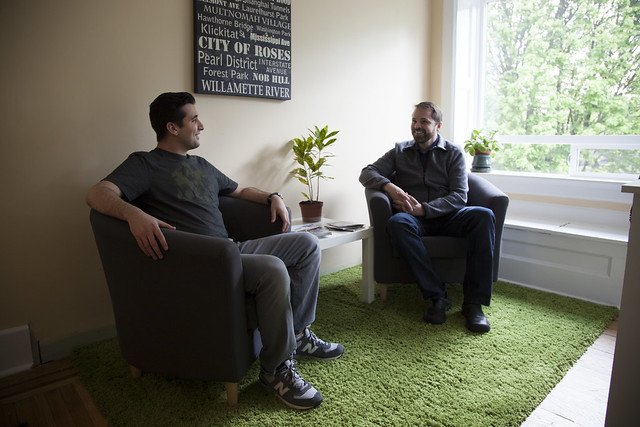
My role as a journalist is to introduce readers to people they may not see. Usually that means 'parting the curtain' on marginalized communities, but occasionally it also means delving into the lives of those on the other end of the fringe. Right now, Oregon and other states are considering a ban on conversion therapy for young people. As people in Oregon testified, they frequently spoke of one local group, Portland Fellowship. I called them up, and they were very open to having a story done. They shared their workbooks and personal stories. The result is a story that's a different focus for me. Check it out:


The world has changed since Portland Fellowship, a nonprofit that aims to deliver people from homosexual desire, first opened a quarter century ago.

Gays and lesbians are more widely accepted across the country. Other "ex gay" leaders have given up the fight -- and in some cases apologized for their earlier work. President Barack Obama has called for an end to conversion therapy for children.

And Oregon lawmakers are poised to ban the practice. Although the bill they're considering wouldn't impact Portland Fellowship, much of the testimony in favor of it has focused on the Southeast Portland organization.

Executive Director Jason Thompson does not care. Business remains steady, he said, and the need is still there.

"Even if the world goes completely pro-gay and gay marriage is the law of the land, people will still come here because they live according to a different system, a different faith, a different priority, worldview than the world," Thompson said.

Portland Fellowship doesn't promote hate, he said. It promotes love.


READ THE REST ON OREGONLIVE

Saturday, May 9, 2015

Team of Dreams

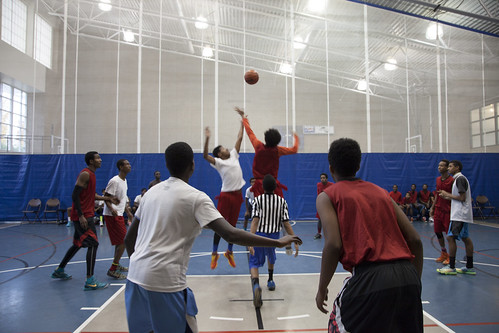
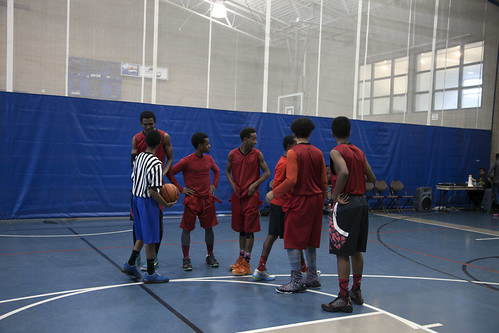
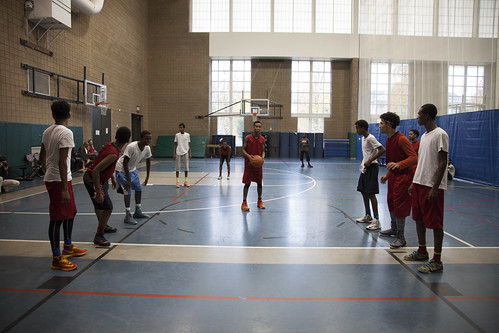
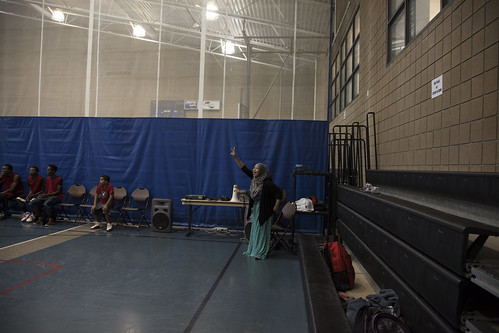
East African All Stars 16

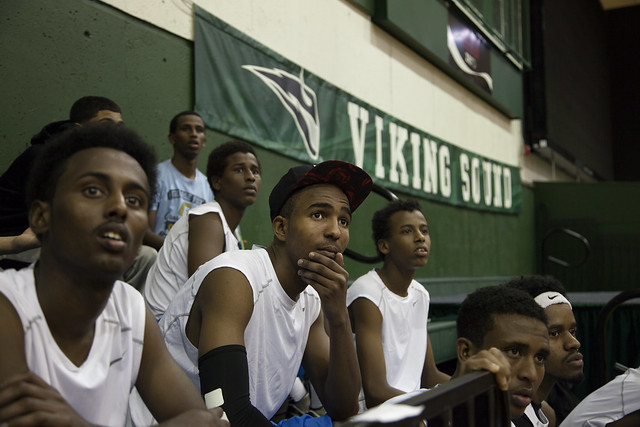
I spent six months following a group of Somali teenagers around. They've been fighting to build a community, to do good even as bad stalks their neighborhoods. Of course, choosing the right path isn't one decision. It's a daily commitment. Sometimes they falter. The story ran a few weeks ago in the Oregonian. Here's a preview:


Mohamed Juma stormed away, memories of sand and civil war still burning inside him.

Back in Kenya, where the Somali teenager lived in refugee camps for 16 years, other boys used to huddle around a cellphone watching YouTube videos of LeBron James. They told Juma, who towered over them at 6-foot-5, that he should go to America and play basketball.

He did. Juma and his family moved to Portland in 2013, and he was soon discovered by the East African All Stars, a makeshift team of teenage boys who played on an elementary school court with rusted rims and tattered nets. Juma's new teammates bought him hamburgers and tennis shoes. Together, they won a city championship and earned support from nonprofit and civic leaders, adults who understood how easy it was for African immigrants to feel adrift in their new homeland and how disappointment can lead boys down dangerous paths. The All Stars, Portland's mayor and police believed, were an answer to the threats facing Juma and other young men.

Yet for Juma, every victory seemed to bring new frustrations. The desert should have been a distant dream, but the good fell away so easily.

This winter, after a squabble about respect and possession time, Juma decided he’d had enough. Later, none of the boys could explain precisely why they had been fighting. All Juma knew for sure was that his best friends had disrespected him.

“If this team doesn’t need me, I quit,” he said.

He trudged home to the crowded East Portland apartment he shares with his mother and seven siblings. He washed and folded the uniform Nike had donated to the team at the mayor’s request.

In the end, adults can do only so much. A boy’s friends define him and his future path. They’re the only choice a young man such as Juma gets to make.


READ THE REST ON OREGONLIVE

Tuesday, April 7, 2015

If I am lost, it's only for a little while

Portland Mercado

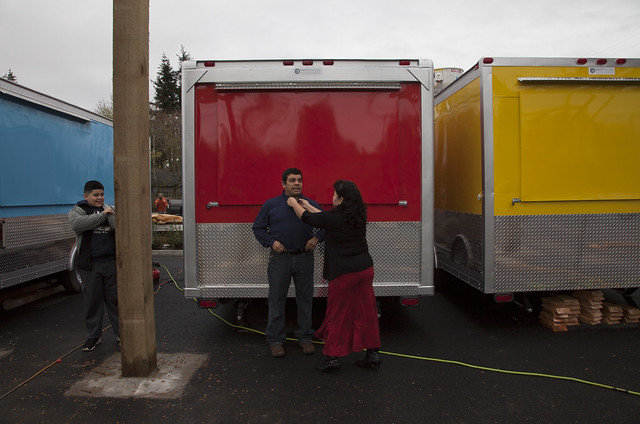
She started at Taco Bell, her hands shaking every time an order came in. In El Salvador, her mother had taught her to use the hands to shape masa into little discs called pupusas. In the United States, the hands had to work quickly, stuffing hard tacos with meat and lettuce, sticking those tacos into bags then out windows -- all under a minute.

She worked at the fast food chain long enough to fix a rhythm. But the job never felt right. Her hands were meant for pupusas. Finally, she took a shot and opened a food cart. The trucks were supposed to be the great equalizer, merging an immigrant's dreams with a hipster's appetite. But she didn't know how to run a business. It closed after six months.

Now, Maria Lizama is trying again. This time, the 48-year-old has an entire community behind her. This time, she has gone through business classes and run drills with her employees. The pupusas -- 2 for 1 on opening day -- will come out fast and hot.

As opening day nears, Lizama worries if her hands will shake again. Or will they remember what her mother taught them?


Read Lizama's story on Oregonlive.

Tuesday, December 30, 2014

December and everything after

Michelle Garfias in dorm 4


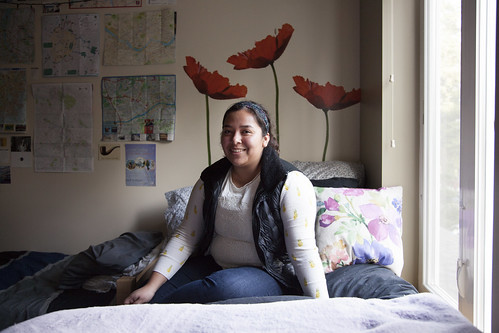
Michelle Garfias left Lewis & Clark College last December assuming she'd be back.

She packed one suitcase. She deep-cleaned her dorm room so it would look nice when she returned. Then she headed home for a Southern California Christmas.

She knew as soon as she saw her father that something wasn't right. Juventino Garfias' muscular frame had withered to that of a featherweight. His skin had gone yellow.

Doctors said it was kidney failure, eerily reminiscent of the kidney infection that had killed Garfias' mother a few years earlier. Her father would live, the doctor said, but he would need years of dialysis. He wouldn't be able to work or watch after Garfias' 13-year-old brother Cesar.

Someone needed to earn money for the family. Someone needed to cook dinners and take Cesar to school. That someone, Garfias thought, had to be her.

So Garfias had a choice: Go back to college and finish her degree, or stay and take care of her father. Friends told her a college degree would change her life forever. But what if her family needed her now?

READ THE REST ON OREGONLIVE.

Tuesday, November 4, 2014

two new good legs on a breeze -bent limb

I'm following around a group of Somali teens for the next month or so as they work to get their basketball team off the ground. They held an invitational for their parents last weekend.

East African All Stars Himo Osman 5

East African All Stars Himo Osman 3

East African All Stars 2

East African All Stars 4

Friday, September 12, 2014

Today, more than any other day

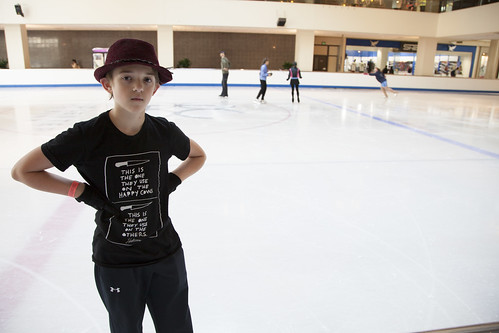
Alex

Because stories begat stories ...

I've been working on a news piece about the local ice skating rink. Dallas developers are remodeling the model and sizing down the rink in the process. It's a fun story -- every one I have met has a Tonya Harding story -- but I found an even better one while watching the ice one day. This is Alex, age 13. I'll be following him over the next three months or so.

Thursday, September 11, 2014

There's intense gravity. I'm just your satellite.

Tongans _ Semise moves to PSU 4

I've spent the past two years following two Tongan best friends in their last year of high school. "The Pact" ran in Sunday's Oregonian. Semise Kofe and Sione Taumoe'anga thought faith, football and friendship could lead them out of poverty. But what would they sacrifice along the way?

The first thing Semise Kofe and Sione Taumoe'anga did together was fight.

It was a Sunday afternoon in 2007, just after services at the Church of Jesus Christ of Latter-day Saints' Rose City 1st Ward. The 11-year-old boys knew of each other. Both their families had come to Portland from Tonga, a tiny Polynesian archipelago in the Pacific Ocean. They lived in the same neighborhood of ranch houses at the city's edge. They both had something to prove.

Later, neither could remember why they fought that day. Boys growing up on the blocks just off North Columbia Boulevard, an especially poor, rough part of eternally downtrodden North Portland, didn't need a reason. They earned power and respect just for swinging.

Taumoe'anga, lanky with the first shade of a mustache, punched Kofe in the mouth. Kofe, neckless and wide, grabbed Taumoe'anga and slammed him against a car.

Other boys from the neighborhood were joining the Crips. Kofe and Taumoe'anga had already lost a few friends to juvenile detention centers. As onlookers pulled the boys apart that morning, Kofe and Taumoe'anga shared the same scary thought: We could be next.

"We gotta do something different, bro," Kofe remembers saying.

A friendship was formed. A deal was made.

Taumoe'anga's uncle ran a makeshift gym in a detached garage near Pier Park. Maybe, Taumoe'anga suggested, he could train them for something more productive. For football.

They showed up for the first session wearing school uniforms and no shoes. Both their fathers worked in concrete, an industry that slowed to a near-halt during Portland's wet winters. They had dress shoes for school, but no sneakers.

Kofe suggested they steal a pair. Taumoe'anga had a better idea: "What about the wires?"

People often threw perfectly fine sneakers -- the laces knotted together -- over telephone pole wires. Several pairs hung in the sky near their homes. They knocked a few sets down before finding a pair of baby blue size 9 knockoffs, then took turns wearing them. Kofe ran laps around the park while Taumoe'anga stood barefoot on the sidewalk. Then Taumoe'anga ran while Kofe waited and watched.

"We're gonna get this done," Taumoe'anga said between laps. "Get better. Prove everybody wrong."

They slapped hands and prayed: "Heavenly father, help us get out of here."

It was a contract made by boys, no more binding than a spit-shake. Later, they took to calling it their pact.


READ THE REST OF THE STORY ON OREGONLIVE.

Saturday, August 16, 2014

'All we wanna do is take the chains off'

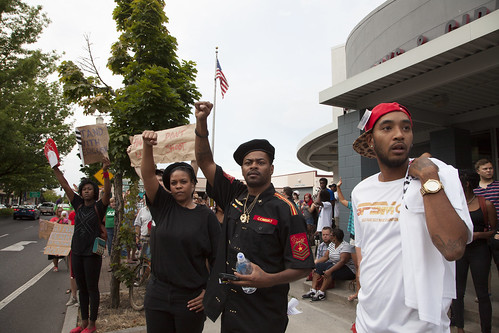
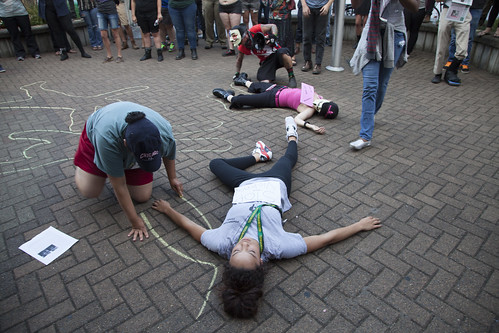
Cities across the country held a National Moment of Silence for Mike Brown and Ferguson, Mo. on Thursday night. Portland had two. The one I attended -- outside a Portland Police Precinct -- grew louder as the night wore on. Here are some photos I made for The Oregonian.

Portland protest for Ferguson

Portland protests for Ferguson 15

Portland protests for Ferguson 30

Portland protests for Ferguson 3

and an excerpt of the story:


Portland protesters stayed mostly on the sidewalks near the Portland Police Bureau North Precinct as the first wave of rush hour traffic traveled up and down MLK. But as the crowd grew, so did the tension.

An offshoot, led by Ionatana Iese of North Portland, formed a barricade in the crosswalk. Business owners from the Vanport Plaza rushed into the street, begging Iese to move out of the sidewalk.

"Open the street up," he yelled. "You're asking for violence. We ain't asking for them to shoot us."

Shareef pointed to the precinct.

"If they come, it's going to get violent, trust me," Shareef said. "It's not us against us. It's us against them."

"People have been singing and marching for years," Iese said. "Right now, we are undirected chaos. This is old. This is archaic. We need to do something that will affect the money. Sitting in traffic is something different."

"You can't fight all the time," Shareef said. "Sometimes you have to be smarter than your oppressors."

Monday, August 4, 2014

The Black Boy Speech

My coworker Beth Nakamura and I made a series of videos recently featuring mothers whose sons are Black, Latino or biracial. The mothers talked about their family's experiences with police and explained "The Black Boy Speech," a talk they've given their sons about how to interact with police. We made six individual videos, which you can watch on The Oregonian's website. But here's the main video, which includes several of the mothers.

The Black Boy Speech: Mothers of color give advice to their sons about interacting with police from Casey Parks on Vimeo.

Thursday, May 22, 2014

Fabio

Fabio meets and greets


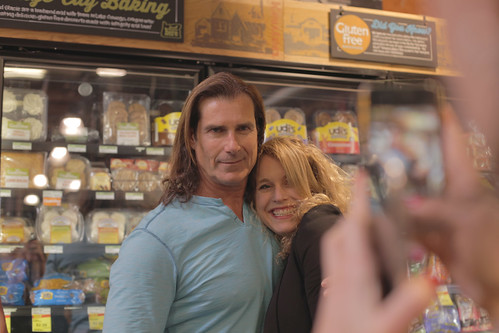
Fabio is in Portland this week, touring the local Whole Foods much to the delight of many women here. I went to the first event and wrote a story. Because: Why not?


Fabio, the Italian heartthrob known for his hunky physique and exquisite mane has parted ways with I Can't Believe It's Not Butter, the spread and spray he advertised in the 1990s.

But he is still catnip to some women, and in the sales world, they call that a sure thing.

He's on a nationwide tour of Whole Foods markets, selling Healthy Planet Nutrition protein powders. And, perhaps more importantly, he is posing for pictures. His first of several Portland appearances was Wednesday on Northeast Fremont Street. Thursday, he'll be at the grocery chain's Pearl District location. Later in the week, he's at the Tanasbourne, Hollywood and Laurelhurst locations.

Women once mobbed him. Cops had to break-up fights in the 1990s as fans fought for a piece of Fabio's 6-foot-3-inch frame, the cover image of countless romance novels.

But heartthrobs come bearded here. Butter is back in style. And the 40 women lining up Wednesday in the gluten free aisle did not seem the mobbing type. They were business women, literary types, and their smiles verged on embarrassed giggles as the clock ticked toward 12.

"We booked a group meeting in Outlook," Alyson Clair confessed. She and 40 coworkers at the apparel company Amer Sports have spent the last few years working alongside a bare-chested, boot-clad cardboard cutout of Fabio.

They bought the cutout for a Halloween party. Eight of the Amer Sports workers loved it so much, they cut out of work to meet the real deal.

"No dudes would come with us," Hart said.

Fabio was late Wednesday, so they posed for pictures with their replica. It's flat, but the sweat pictured dripping down the chest gives it a lustful, if not lifelike, quality.

"We're wondering if this is a no shoes, no shirts, no service kind of place," Kristin Normansen said. A passing Whole Foods worker stopped with an official word from on high: The grocery gods would let the 55-year-old Fabio remove his shirt.

When he did arrive, his tresses still extended to the ends of the earth -- or at least well past his shoulders. But his chest was not bare. Instead, he wore cowboy boots, snug-fitting jeans and a T-shirt tight enough to leave little to the imagination.

"Oh my god, his hair is flowing," Clair said.

"He looks good, so luscious," said Jessica Neciuk, a 22-year old on her lunch break. "He's beautiful. Everyone in my office made fun of me: 'He's twice your age.' But I don't care. I'm a sucker for long hair."

Fabio and an assistant set up in the frozen food aisle, a good 10 yards from the butter and butter substitutes. The assistant blended protein power into almond milk while our hunk talked chemistry.

"Your body is 60 percent water, 40 percent protein," he said before delving deep into something called the "biological value scale."

The Italian accent gave everything Fabio said an air of the profound. But after 10 minutes of scientific talk, giggles had sharpened to pursed lips.

Jocelyn McAuley and Kellie O'Donnell interrupted the lecture. They had raided their friends' costumes closets to assemble outfits befitting the cover of a romance novel and sneaked out of work to see Fabio. This was a bucket-list ambition; Mcauley's mother would be so jealous.


Yet as midday stretched into afternoon, they lost patience.

"I'm sorry, we have to go soon," Mcauley said. "Can we please get a picture?"

Fabio paused and furrowed his brow -- giving them the sexy stare of a book jacket bodice ripper. The romance cover replicas posed for their picture then rushed out, clutching their skirts in one hand and cell phones in the other.

"OK, if you come here, I explain you then we take the pictures," Fabio told the rest of the women. "Most of the world is confused right now. All these people, they give you a lot of bologna and very little science."

He held up a bottle of protein powder: The unpasteurized, sugarless mix is kosher and gluten free. It has high levels of lactoferrin, immunoglobulins and bovine serum albumin.

And it is delicious.

Well, at least more delicious than other protein drinks the women said they had tried. It was light and slightly frothy, they said, not too chalky or sweet.

Men suddenly appeared from the aisles to sip the chocolate and vanilla mixes from tiny paper cups. A lesbian said she was considering switching teams.

"Everybody thinks beans are such a great protein," Fabio said. "They are not. They are bottom of the scale. Even a potato has more protein. There is a lot of marketing and very little science."

At $32 for 10 ounces, his mix is expensive. But other protein powders supplement the good stuff with sugar and chemicals, he said.

"Give the people the right thing, and it will be right forever," he said.

They bought the powder, but in this case, the right thing turned out to be pictures.

-- Casey Parks

Sunday, March 30, 2014

if I stay here, trouble will find me

I spent a few months with Dracey as part of my recent project documenting rappers from North Portland. The package is a multimedia piece that includes sound clips, photographs by Beth Nakamura and these short documentaries I made of each rapper. For the video on Dracey, we went back to the three-bedroom apartment he once shared with 13 other people. We also visited his old high school, where he recorded his first album in a utility closet.


Glenn Waco revisits the places that inform his music from Casey Parks on Vimeo.


To see the stories, check out Straight Outta St. Johns.

Wednesday, March 19, 2014

to places we don't know

Sunny March days on the beat, following sisters Kiera Brinkley and Uriah Boyd around as they prepare for a dance duet:


You can read the story on Oregonlive.

Thursday, March 13, 2014

If I mentioned all of my skeletons, would you jump in the seat?


My big multimedia project about Portland rappers came out last week. It's a package of four stories and three videos I made, along with black and white photographs from Beth Nakamura. I feel really grateful to have had the time to work with these musicians on telling their stories. NPR Music and Longreads both linked to the project, and it looks like the boys have sold some records in its wake. I went on Oregon Public Broadcasting this week, too, to talk about the stories.

Check out the whole project, called "Straight Outta St. Johns," for the full effect, but in the meantime, here's one of the videos.

Egbe Vado: A loss threatens the rapper's dreams from Casey Parks on Vimeo.


Egbevado Ananouko’s family left West Africa banking on the American dream and found minimum wage jobs instead. Like other St. Johns teenagers, Ananouko saw hip-hop as a path out of the neighborhood. Rap music’s tales of gold chains and suped-up cars gripped Ananouko. But unlike his peers, the wiry, thickly accented Ananouko built his music studio hoping to secure something more pedestrian: acceptance.

Wednesday, February 5, 2014

everything above my brain is sovereign airspace

Another sneak peek from my upcoming rap project: Spent a few hours watching guys freestyle under the St. Johns bridge. This one went on for three minutes and really blew my mind. What a talent.


{fragments} illmaculate cyphers under the St. Johns Bridge from Casey Parks on Vimeo.

Thursday, January 30, 2014

the white caps of memory, confusing and violent

Here's a preview of a short documentary I made, coming soon to The Oregonian.

{fragments} Egbevado's lost days from Casey Parks on Vimeo.

Sunday, December 8, 2013

decipher prophecies through a mic and say peace

Mic Capes - Innercity Tantrum from Casey Parks on Vimeo.


I've been working on a series of videos about St. Johns rappers this month. I had two of the guys do a Capella versions of their songs for me. Mic Capes was raised in foster homes, instant ramen and the music of Tupac and Nas. He works at recreation centers now, using rap to connect with kids.

Tuesday, November 26, 2013

Thursday, November 14, 2013

So on that note, I'm leaving after this song

Mic Capes

In which Mic tries to write his way to a better life.